Wall Street closes at a record for the first time since end of January
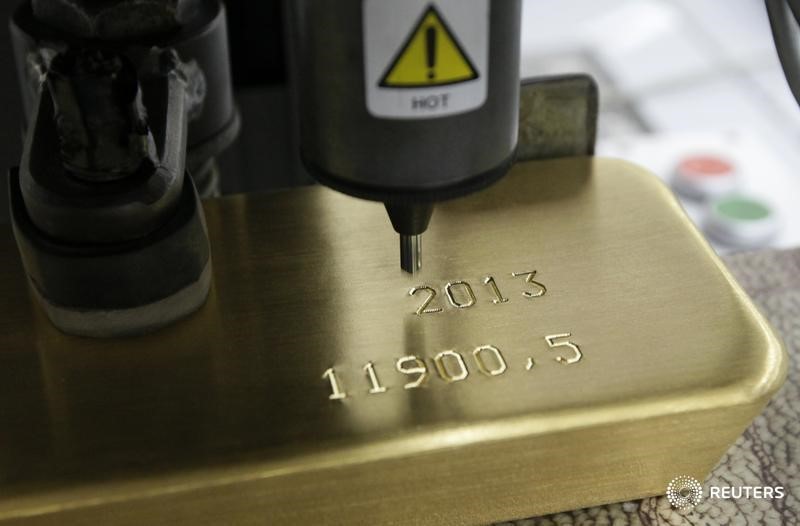
Investing.com -- Gold prices were higher on Tuesday, boosted by a weaker U.S. dollar after cooler-than-anticipated U.S. producer inflation data. Continued hopes of a permanent ceasefire between the U.S. and Iran buoyed risk appetite.
At 15:17 ET (19:17 GMT), spot gold was up 2.1% to $4,840.09/oz, while gold futures added 2% to $4,864.67/oz.
Get more insights into gold and the war in Iran with InvestingPro - now 50% off
U.S. producer inflation growth not as much as feared
The March U.S. producer price index (PPI) report came in much better than feared on Tuesday. The headline figure ticked up 0.5% month-on-month and 4.0% year-on-year, compared to the consensus estimates of 1.1% and 4.6%, respectively.
The 12-month increase in the headline figure was the largest since February 2023, driven mainly by a 8.5% month-on-month jump in the index for final demand energy prices.
While an impact from surging oil prices due to the Iran conflict was expected to show up in the report, investors were soothed by the headline miss.
"This PPI report shows inflation isn’t gaining momentum—it’s being influenced by external shocks. Energy is driving the upside, and with geopolitical tension around key oil routes, those price moves can happen quickly and filter through the system," Gina Bolvin, president of Bolvin Wealth Management, said.
"Underneath that, core inflation is relatively steady, which suggests the broader economy isn’t overheating. That split is what makes this moment tricky," Bolvin added.
Risk sentiment was boosted after the PPI data, leading traders away from safe haven assets such as the dollar, which boosted gold. Softness in the greenback, which has emerged as a safe haven of choice during the current Middle East conflict, can make gold more attractive to overseas buyers, possibly boosting demand.
Gold usually acts as a safe haven of choice during geopolitical crises, but it has taken a backseat to the dollar this time. The U.S. is viewed as a net energy exporter, which could help insulate the American economy from disruptions to oil flows from the Persian Gulf. Moreover, expectations of potential interest rate hikes to combat the inflationary shock from spiking oil prices have also weighed on the yellow metal.
Trump hints at more talks amid U.S. blockade of Hormuz
President Donald Trump on Tuesday told the New York Post that more talks "could be happening over the next two days" in Pakistan.
Washington and Tehran have continued to engaged with one another and there has been some forward motion toward a permanent ceasefire deal, Reuters earlier reported.
Trump has also noted that the White House had been contacted by Iranian officials who would like to "make a deal," adding that Iran will not have a nuclear weapon. Washington has reportedly demanded that Iran agree not to enrich uranium, a key part of the process of building a nuclear weapon, for 20 years.
Meanwhile, Pakistan, which has emerged as a key mediator between the U.S. and Iran, has offered to host a second round of discussions prior to the end of the ongoing two-week ceasefire, according to reports. The first talks were held in Islamabad last weekend, but failed to give way to any agreement.
Elsewhere, Israel and Lebanon are due to begin direct peace talks in Washington on Tuesday. Air attacks by Israel on targets in Iran-aligned Hezbollah targets in Lebanon have been a key sticking point threatening the fragile halt to hostilities between the U.S. and Iran.
U.S. Secretary of State Marco Rubio will take part in the discussions between Israel and Lebanon, the WSJ said, quoting a State Department official.
Ambar Warrick and Scott Kanowsky contributed to this article


