Trump says Iran war "close to over" amid hopes for more negotiations
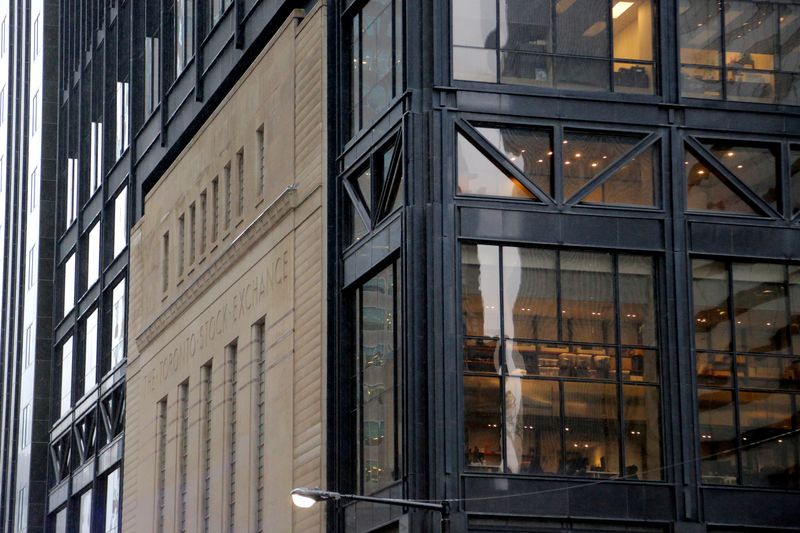
Investing.com - Canada’s main stock index is trading higher on Tuesday, with investors eyeing reports of progress in negotiations between the U.S. and Iran despite an ongoing American naval blockade.
By 12:41 ET (17:41 GMT), the S&P/TSX 60 index had risen by 8 points, or 0.6%. The S&P/TSX composite index is up 165 points or 0.5%.
The S&P/TSX composite index gained 0.5% to end at 33,879.24 on Monday, floating around an almost six-week high.
U.S. stocks rise
U.S. stock indices are also trading higher. The Dow is up by 291 points, or 0.6%, the S&P 500 has climbed by 71 points, or 1.1%, and the Nasdaq has climbed 407 points, or 1.8%.
The main averages on Wall Street advanced in the prior session, as initial disappointment that a weekend round of talks between Washington and Iran did not yield an immediate agreement faded. U.S. President Donald Trump also noted that the White House had been contacted by Iranian officials and wants to "make a deal," adding that Iran will not have a nuclear weapon.
At the same time, a U.S. blockade of Iranian ports came into effect on Monday, potentially further restricting already shuttered oil flows through the Strait of Hormuz. The International Energy Agency has warned that oil prices, which have fallen but remain well above levels before the start of the joint U.S.-Israeli assault on Iran in late February, may not yet be factoring in the severity of the supply shock.
"Whilst headlines offer little reason for optimism, markets seem to take more of a wait-and-see approach rather than assuming what will happen. If anything, the glass is still half-full when looking at risk assets," ING analysts said in a note.
Oil dips
The standoff between the U.S. and Iran continued on Tuesday, although Reuters reported that both sides have been engaging with one another and there has been some forward motion toward a deal to make their two-week ceasefire permanent.
Trump has also noted that the White House had been contacted by Iranian officials who would like to "make a deal," adding that Iran will not have a nuclear weapon. Washington has reportedly demanded that Iran agree not to enrich uranium, a key part of the process of building a nuclear weapon, for 20 years.
Meanwhile, Pakistan, which has emerged as a key mediator between the U.S. and Iran, has offered to host a second round of discussions prior to the end of the ceasefire, according to reports. The first talks were held in Islamabad last weekend.
Elsewhere, Israel and Lebanon are due to begin direct peace talks in Washington on Tuesday. Air attacks by Israel on targets in Iran-aligned Hezbollah targets in Lebanon have been a key sticking point threatening the fragile halt to hostilities between the U.S. and Iran.
U.S. Secretary of State Marco Rubio will take part in the discussions between Israel and Lebanon, the WSJ said, quoting a State Department official.
Against this backdrop, oil prices dipped back below $100 a barrel, but pared back some of these losses, amid guarded optimism for a deal to end the fighting in the Middle East. Brent crude futures, the global benchmark, were last down by 1.2% at $98.14 a barrel, while U.S. West Texas Intermediate crude futures declined by 2.5% to $96.64 a barrel.
Gold firms
Gold prices rose on Tuesday, buoyed by a softer U.S. dollar. Spot gold edged up 0.7% to $4,770.73 an ounce by 08:13 ET, while gold futures added 0.5% to $4,793.20/oz.
Bullion was supported by weakness in the dollar, with markets looking to some de-escalation in the Iran war despite an ongoing U.S. naval blockade of Iranian ports. Softness in the greenback can make gold more attractive to overseas buyers, possibly boosting demand.
While gold is typically viewed as a bulwark against geopolitical strife, investors have broadly looked to the dollar for safety during the Middle East conflict. The U.S. is viewed as a net energy exporter, which could help insulate the American economy from disruptions to oil flows from the Persian Gulf. Signs of de-escalation between the U.S. and Iran, as a result, have recently weighed on the dollar and bolstered gold.
JPMorgan, Wells Fargo earnings in focus
Attention is now turning to earnings from major U.S. banks, including JPMorgan Chase and Wells Fargo.
JPMorgan posted better-than-expected first-quarter revenue, bolstered by recent market volatility that spurred on its equity-market trading business.
Along with the energy shock sparked by the war in Iran, investors have been grappling with ructions in stock markets caused by worries over disruptions from new artificial intelligence-powered tools. Trading desks at big banks like JPMorgan tend to benefit from increased movements in equities, as this can force clients to reposition portfolios and make more trades to hedge risks.
Despite the volatile market backdrop, banking executives have also described a persistently strong environment for dealmaking. Hopes are high that 2026 will be a year marked by massive transactions, particularly in the possible public listings of prominent AI and space firms.
Group-wide, adjusted revenue stood at $50.54 billion, topping Bloomberg consensus expectations of $49.26 billion. Net income grew to $16.5 billion, or $5.94 a share, versus $14.6 billion, or $5.07 apiece, a year ago.
Still, CEO Jamie Dimon flagged an "increasingly complex set of risks" around the wider economic outlook, including geopolitical tensions and wars, energy price fluctuations, murky global trade policies, large fiscal deficits and elevated asset prices.
Peer Wells Fargo’s preliminary first-quarter revenue and net interest income also grew, with the lender highlighting solid consumer and business financial health.
However, the group warned that the impact of the Iran-linked oil price surge will take time to materialize, adding that it is positioned for a range of economic scenarios.
Shares of both JPMorgan and Wells Fargo were lower in premarket U.S. trading.